How to Nurture Your Child’s Gifts Without Overwhelm

A Homeschool Mom’s Guide to Encouraging Talents While Keeping Family Life Peaceful
One of the great joys of homeschooling is the opportunity to nurture the unique gifts, talents, and interests God has placed in each of our children. We notice the child who sketches for hours, the one who builds elaborate creations from cardboard and tape, or the one who devours books about animals, space, or history.
But along with that joy can come pressure.
Should we sign them up for sports? Music lessons? Art classes? Coding camps? What if we miss the one opportunity that could help them discover their calling?
Many homeschool parents worry that if they don’t expose their children to every opportunity, they might miss something important. But the truth is that nurturing your child’s gifts doesn’t require an exhausting schedule.
In fact, many families discover that a slower, more intentional pace creates the best environment for talents to grow.
In a thoughtful conversation on the Schoolhouse Rocked Podcast, homeschooling mom and author Jamie Erickson shared wisdom that resonates deeply with many parents:
“You can have a passion-filled child without losing your mind.”
That balance—encouraging gifts without losing family peace—is exactly what many homeschool families are searching for.
Understanding the Difference Between Natural and Nurtured Gifts
One of the first steps in helping children develop their talents is recognizing the difference between natural gifts and nurtured gifts.
As Jamie Erickson explains:
“There is a difference between a natural gift and a nurtured gift. You can have a beautiful raw piece of clay, but if you do nothing with it to help refine it and mold it into what God intended… you’re missing the mark.”
Children often show early signs of aptitude—whether it’s music, athletics, art, writing, problem solving, or leadership. But those natural inclinations still need encouragement, practice, and opportunity to grow.
At the same time, parents should be careful not to push children toward activities simply because they are popular or culturally expected. Each child’s path will look different.
Our role as parents is not to manufacture talents—but to observe, encourage, and steward the gifts God has already placed in our children.
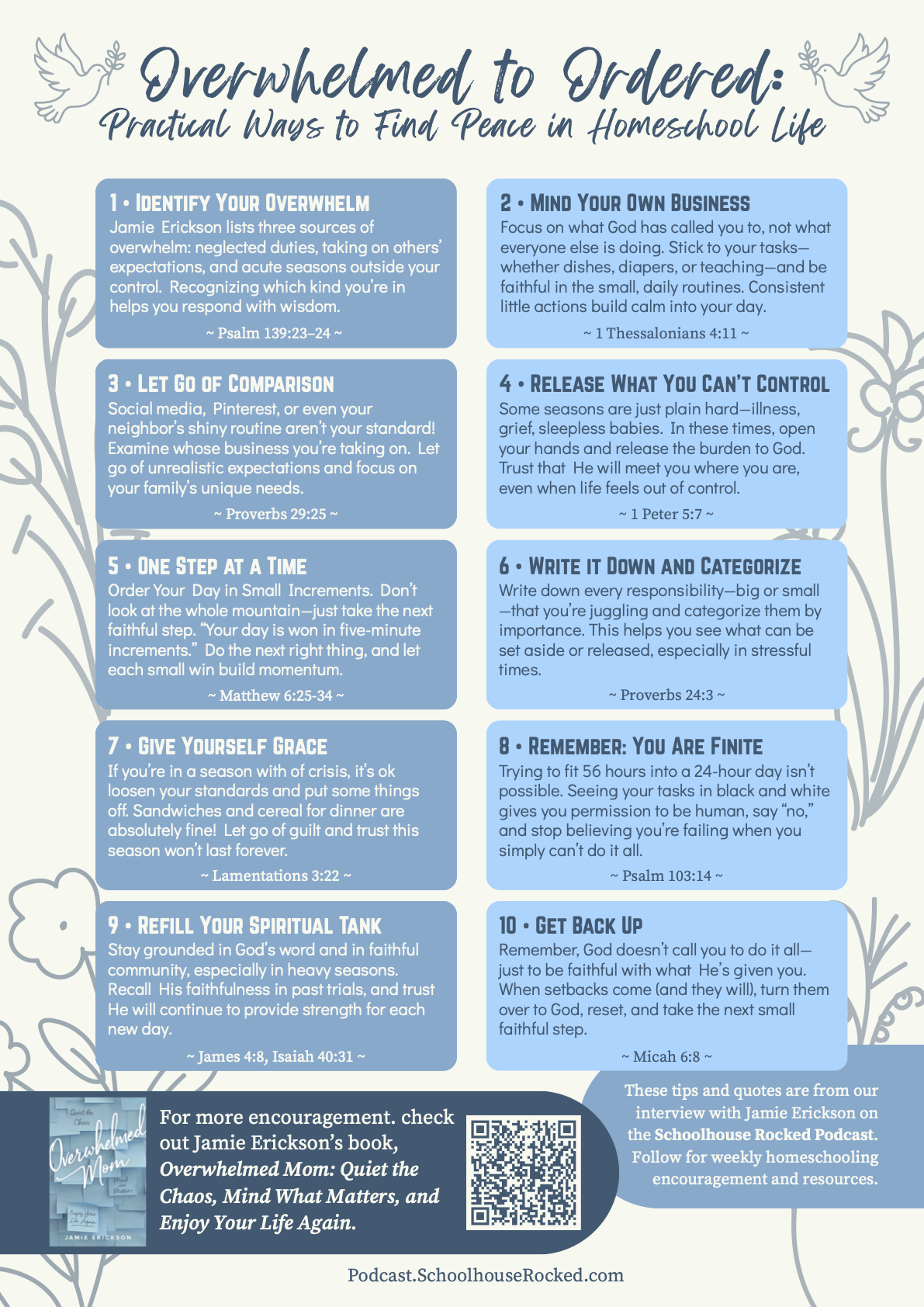
Feeling overwhelmed in your homeschool? You’re not alone—and peace is possible.
From Overwhelmed to Ordered: 10 Practical Ways to Find Peace in Your Homeschool Life is a beautifully designed, faith-filled printable created to encourage and steady Christian homeschool moms in busy or difficult seasons.
This handout walks you through ten gentle, actionable steps to help you identify the source of your overwhelm, release what isn’t yours to carry, and move forward one faithful step at a time.
Inside this printable, you’ll find:
Clear, compassionate guidance for navigating homeschool overwhelm
Encouraging reminders to focus on your calling—not comparison
Practical tools for ordering your days in small, manageable increments
Scripture thoughtfully paired with each point
Grace-filled encouragement for hard seasons, setbacks, and fresh starts
Perfect for printing and keeping in your homeschool planner, posting in your school room, or sharing with a friend who needs encouragement, this resource is designed to bring calm, clarity, and hope right where you are.
Whether you’re juggling multiple ages, walking through a hard season, or simply feeling stretched thin, this printable reminds you that God doesn’t call you to do it all—only to be faithful with what He’s given you today.
Why Over-Scheduling Often Backfires
In today’s activity-driven culture, many parents assume that the best way to discover a child’s gifts is by enrolling them in as many programs as possible.
Sports leagues, music lessons, dance classes, clubs, camps, and competitions can quickly fill a family calendar.
But this approach can have unintended consequences.
Jamie Erickson cautions that when children are constantly moving from activity to activity, families often experience:
Overstimulated children
Less meaningful time together
None of these opportunities are necessarily inherently wrong. The problem comes when every opportunity becomes an obligation.
As Jamie wisely notes:
“You have not only an overstimulated child… sometimes an overwhelmed child, you have a very overwhelmed mother.”
Instead of creating thriving learners, overscheduling often creates stress.
The “Sample and Survey” Approach to Discovering Interests
One of the most helpful ideas Jamie shares is the concept of “sampling and surveying.”
Especially in the early years, children don’t need intense training programs to discover what interests them. Instead, they benefit from gentle exposure to many different ideas and experiences.
And much of that discovery can happen right at home.
She explains:
“You don’t even have to leave the comfort of your house to sample and survey.”
Simple activities can spark curiosity and reveal hidden interests:
Reading rich and engaging books together
Encouraging imaginative play
Providing art supplies or building materials
Visiting libraries and museums
Exploring nature
Trying occasional one-day classes or workshops
These low-pressure experiences allow children to explore widely without overwhelming the family schedule.
When Children Are Ready to Go Deeper
Many parents worry that if their child doesn’t start an activity early enough, they will fall behind.
But that fear is often unnecessary.
Schoolhouse Rocked Podcast host, Cindy West points out that many children don’t truly discover their strongest interests until later:
“Often we don’t really even need to start that on a serious level until middle school.”
The early homeschool years are primarily about building foundations:
curiosity
character
work ethic
basic academic skills
a love of learning
As children mature, their interests often become clearer.
Many times a child may discover a passion seemingly “late,” but still progress quickly if they have natural aptitude and strong motivation.
A Simple Rule for Busy Families: One Thing Per Child
For families with multiple children, activities can quickly multiply.
A simple guideline shared by Jamie Erickson can help keep life manageable:
Each child chooses one primary activity per season.
As she explained:
“I want to nurture your gifts, but I am one person and there are five of you… you may do one thing per season and only one thing.”
This approach provides several benefits:
Protects family schedules
Teaches commitment and follow-through
Encourages children to support their siblings
At the end of a season, children can decide whether to continue or try something new.
Creating Space for Creativity at Home
One of the most powerful ways to nurture children’s talents is simply creating space for exploration at home.
Jamie encourages parents to intentionally make room for their children’s interests:
“Providing an actual space for them in your home says: your gift matters. I see it.”
This might include:
a dedicated art table
musical instruments available for practice
shelves filled with inspiring books
a workshop or building area
time set aside each afternoon for creative exploration
Often, these simple opportunities lead to deeper engagement than highly structured programs.
Focus on Strengths Without Ignoring Responsibilities
Every child has strengths and weaknesses. While core subjects remain important, not every area needs equal attention.
Jamie encourages parents to invest their greatest energy where children naturally thrive.
She explains:
“Do I give him a pass for math? No. But do I stress out and put all my energy into something he obviously is not gifted at… or do I focus our best reserves on the thing he clearly loves?” Don’t ignore the basics, but focus on the things that matter—and yield the most fruit.
Children still learn essential skills—but their greatest passions receive the support they need to flourish.
The Freedom to Say “No”
One of the most powerful tools homeschool parents have is the ability to say no.
Overcommitment is one of the primary causes of family stress. When every activity becomes a “yes,” schedules quickly spiral out of control.
Jamie offers a helpful perspective:
“You get overwhelmed when you have misaligned priorities.”
Learning to say no protects the family rhythms that make homeschooling sustainable and joyful.
Building a Family Culture of Encouragement
A slower pace also strengthens family relationships.
When children aren’t constantly scattered across activities, they have opportunities to:
cheer for their siblings
spend meaningful time together
learn patience and empathy
As Jamie observes:
“You are giving your other children an opportunity to rejoice with those who rejoice.”
Instead of living parallel lives, families grow together.
Encouragement for Homeschool Parents
If you sometimes feel pressure to do more, sign up for more, or keep up with everyone else, take heart.
Your children do not need a packed calendar to flourish.
They need:
loving guidance
opportunities to explore
encouragement in their strengths
time to grow at their own pace
a peaceful home where curiosity is welcomed
Your home is enough.
Your family rhythms are enough.
And God is faithful to guide each child’s path.
If you’d like to hear the full discussion that inspired many of these ideas, you can listen to Cindy West and Jamie Erickson’s conversation on the Schoolhouse Rocked Podcast, where they dive deeper into nurturing children’s gifts while protecting family peace.

Quick Takeaways:
How Do You Nurture Your Child’s Gifts Without Overwhelming Your Family?
Homeschool parents can nurture their children’s gifts without overwhelm by:
Allowing children to sample different interests at home
Avoiding over-scheduling activities
Encouraging one focused activity per season
Creating space for creativity and exploration
Prioritizing family rhythms and rest
This simple approach helps children discover their passions while maintaining a peaceful home environment.
Frequently Asked Questions About Nurturing Children’s Gifts
How do you discover your child’s talents?
Children often reveal their interests through play, curiosity, and repeated activities they enjoy. Homeschool parents can help by exposing their children to books, creative play, nature exploration, and hands-on learning experiences.
Do children need lots of activities to discover their gifts?
No. Many children discover their passions through simple home experiences like reading, building, drawing, or exploring outdoors. Too many scheduled activities can actually overwhelm both children and parents.
What age should children start specializing in a skill?
Many educators recommend waiting until middle school before focusing heavily on a specific activity. The early years are best used for broad exploration and building foundational skills.
What if my child loses interest in something?
It’s normal for children’s interests to change as they grow. Finishing a commitment teaches perseverance, but it’s healthy to allow children to try new things in the next season.
